
 EN
EN



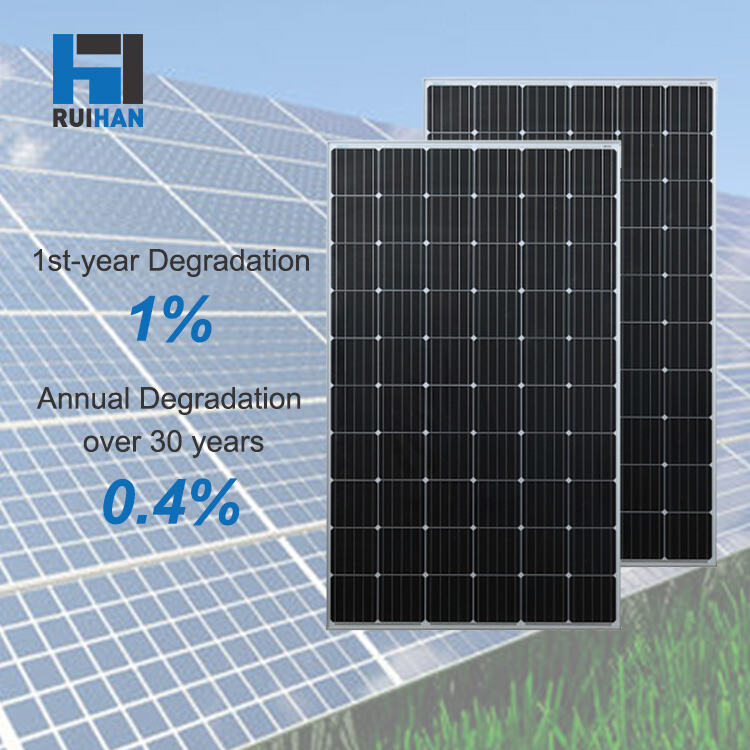
Core Technologies Driving Solar Panel Efficiency Gains
Monocrystalline PERC and N-Type Silicon: Industry-Standard High-Efficiency Solar Panels
Monocrystalline silicon panels with PERC (Passivated Emitter and Rear Cell) technology dominate today’s high-efficiency market, leveraging ultra-pure silicon wafers and rear-surface passivation to minimize electron recombination. This architecture enables 22–24% conversion efficiency in commercial panels—outperforming polycrystalline alternatives by 4–6 percentage points. N-type silicon substrates further reduce light-induced degradation, maintaining 92% of initial output after 25 years versus 80–85% for conventional P-type cells. Leading manufacturers now integrate bifacial designs that harvest reflected light, boosting annual yield by 11–23% depending on ground albedo, as confirmed in multi-year field studies.
Emerging Architectures: TOPCon, HJT, and Perovskite-Silicon Tandems in Commercial Solar Panels
Next-generation TOPCon (Tunnel Oxide Passivated Contact) cells achieve 25–26% efficiency by reducing surface recombination through ultra-thin oxide layers. HJT (Heterojunction Technology) combines amorphous and crystalline silicon to deliver superior temperature coefficients (–0.25%/°C vs. –0.35%/°C for PERC). Perovskite-silicon tandems now approach 30% efficiency in pilot production, with IRENA reporting their potential to increase energy density by 50% versus monocrystalline modules. Though currently at premium pricing, these technologies demonstrate 3–5% higher daily energy harvest in real-world conditions—critical for space-constrained installations where maximizing watt-per-square-meter directly impacts ROI.
Why Module-Level Quality Matters More Than Cell-Level Efficiency Alone
Bridging the Lab-to-Field Gap: How Real-World Solar Panels Underperform Rated Efficiency
Manufacturers tout peak solar panel efficiency ratings measured under Standard Test Conditions (STC), yet real-world deployments consistently underperform lab results—often by 5–15% annually. This lab-to-field gap arises from environmental stressors and module-level flaws not captured in isolated cell testing. Unlike controlled labs, installed panels face temperature fluctuations, humidity, UV exposure, and mechanical loads that accelerate degradation.
While cell efficiency determines theoretical energy potential, module-level quality dictates actual power delivery. Thin-film micro-cracks, inadequate encapsulation, or poor soldering emerge only after installation—and directly undermine performance. Temperature coefficients also play a critical role: panels losing 0.4%/°C versus 0.29%/°C can yield 8% less power annually in hot climates. Installation factors compound the gap—uneven shading, soiling, or suboptimal tilt angles rarely factor into lab ratings. Leading operators report 2–8% energy loss from micro-cracks alone within three years of operation. This divergence confirms that durable materials and rigorous manufacturing standards—not marginal cell efficiency gains—deliver superior lifetime yield.
Non-Efficiency Factors That Define Real-World Solar Panel Performance
Temperature Coefficient, Bifacial Gain, and Advanced Cell Interconnection in Modern Solar Panels
While peak efficiency ratings grab attention, real-world solar panel performance hinges on non-cell factors. Temperature coefficient—measuring output loss per degree above 25°C—directly impacts energy yield. High-quality panels maintain only 0.3–0.5% degradation per °C rise, versus 0.4–0.6% in budget alternatives. Because modules frequently operate at 45–65°C under Nominal Operating Cell Temperature (NOCT) conditions, this difference causes 10–25% efficiency drops in hot climates.
Bifacial designs capture reflected light, boosting yields by 5–25% depending on ground surface reflectivity. Meanwhile, advanced cell interconnection—such as multi-busbar or shingled layouts—minimizes power loss from microcracks, a critical durability feature since mechanical stress causes 0.5–2% annual degradation in standard panels.
These factors create stark performance gaps: premium solar panels deliver 75–90% of lab-rated output in actual installations, while lower-tier modules often fall below 70%. Prioritizing these attributes ensures consistent energy harvest when environmental variables deviate from ideal test conditions.
Optimizing Solar Panel Selection for Maximum Energy Yield and ROI
Matching Solar Panel Technology to Climate and Site Conditions
Selecting solar panels requires matching technology to environmental factors. Monocrystalline panels deliver peak performance in cooler regions due to lower temperature coefficients, while bifacial modules generate up to 27% more energy in snowy or highly reflective environments. For high-temperature areas, thin-film panels with superior heat tolerance minimize efficiency losses. Coastal installations benefit from corrosion-resistant frames, and urban sites with space constraints prioritize high-wattage panels. Shading analysis determines whether PERC or TOPCon cells better mitigate power drop-off. System designers must also evaluate roof load capacity, tilt angles, and local weather patterns—arid desert sites demand different optimization than humid subtropical locations.
LCOE and ROI Analysis: The True Value of High-Quality Solar Panels
High-quality solar panels demonstrate their value through Levelized Cost of Energy (LCOE) and Return on Investment (ROI) metrics. While premium panels cost 15–20% more upfront, their 30% lower degradation rates and 25-year linear power warranties yield 40% more lifetime energy. This reduces LCOE—the lifetime system cost per kWh—by 22% compared to budget alternatives. ROI calculations must incorporate:
| Factor | Impact on Financial Returns |
|---|---|
| Energy yield | High-efficiency panels generate more kWh/kWp |
| Degradation rate | <0.5%/year preserves long-term revenue |
| Durability | Fewer replacements reduce O&M costs |
| Incentive alignment | Meets tax credit/renewable certificate thresholds |
Projects using tier-1 panels achieve ROI in 5–7 years versus 8–10+ for economy-grade modules, proving superior lifetime value despite higher initial investment.
FAQ
What are Monocrystalline PERC solar panels?
Monocrystalline PERC panels are a type of solar panel that uses Passivated Emitter and Rear Cell technology to improve efficiency. They are known for high conversion efficiency and reduced light-induced degradation.
How does temperature coefficient affect solar panel performance?
The temperature coefficient indicates how well a solar panel performs at temperatures above 25°C. A lower temperature coefficient means less energy loss in high-temperature environments.
Why do real-world solar panels perform differently than their rated efficiency?
Real-world conditions, such as temperature fluctuations, shading, soiling, and non-ideal tilt angles, contribute to the difference between lab-rated and actual solar panel efficiency.
What is the importance of LCOE in solar panel selection?
Levelized Cost of Energy (LCOE) measures the cost of energy produced by a solar panel over its lifetime. It helps in assessing long-term financial returns and comparing different solar technologies.