
 EN
EN



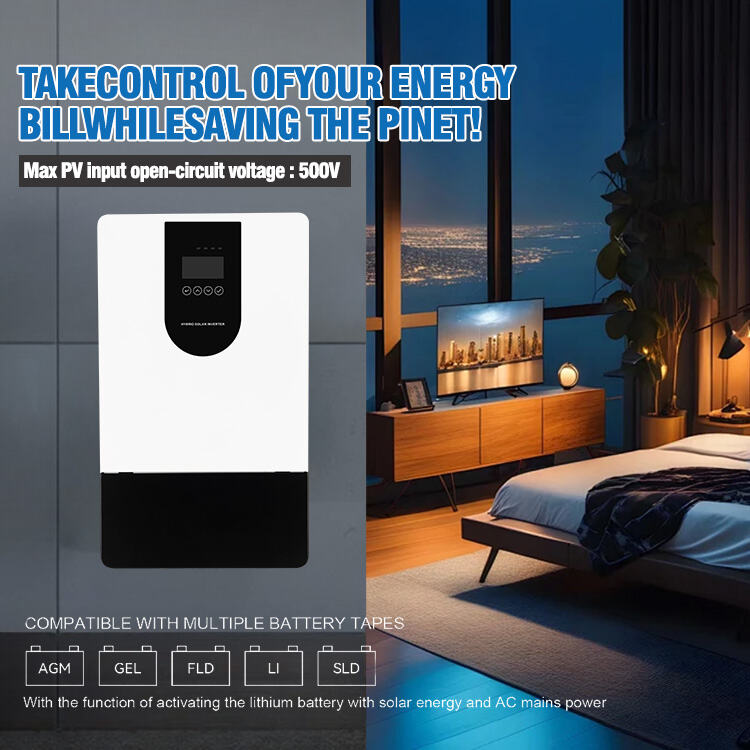
What Is a Hybrid Solar Inverter? Core Functions and Working Principles
Dual-role architecture: Seamlessly managing solar generation, battery storage, and grid interaction
A hybrid solar inverter serves as the central nervous system of modern home energy systems—integrating solar generation, battery storage, and grid interaction into a single intelligent platform. Unlike traditional string or microinverters, it dynamically allocates power in real time: directing solar output to immediate loads, charging batteries with surplus energy, or exporting excess to the grid. This unified architecture eliminates the need for separate inverters and battery controllers, reducing installation complexity, wiring, and balance-of-system costs. Crucially, it enables seamless backup operation during outages—automatically isolating the home from the grid (islanding) and powering critical circuits without interruption. The result is greater energy resilience, higher self-consumption rates, and simplified system management.
Key efficiency-enabling technologies: MPPT optimization, bidirectional power flow, and intelligent DC–AC conversion
Three foundational technologies distinguish high-performance hybrid inverters:
- Advanced MPPT algorithms, often with dual or multi-channel tracking, continuously optimize voltage and current to extract maximum power from solar arrays—even under partial shading or rapidly changing weather, improving yield by up to 30% over basic inverters.
- Bidirectional power flow supports flexible energy routing: batteries can charge from solar or the grid (e.g., during off-peak tariffs), and discharge to support loads or export to the grid when prices are high—enabling true time-of-use arbitrage.
- Intelligent DC–AC conversion, powered by high-efficiency silicon carbide (SiC) or gallium nitride (GaN) semiconductors, achieves peak efficiencies exceeding 97% in premium models. These inverters also provide reactive power support (VAR control) to stabilize local grid voltage and frequency—an increasingly essential function as distributed solar penetration rises.
Evaluating True Efficiency: CEC-Weighted Ratings and Real-World Performance Factors
Why >95% CEC-Weighted Efficiency is Critical for Home Solar Inverter ROI and Energy Yield
The California Energy Commission (CEC)-weighted efficiency rating reflects real-world performance across varying irradiance levels—simulating dawn-to-dusk conditions more accurately than peak-efficiency specs alone. A rating above 95% is a strong indicator of consistent, high-yield operation: a 97% efficient inverter versus a 92% model can deliver ~5% more annual energy from identical panels. Over a 25-year lifespan, that difference compounds into thousands of additional kilowatt-hours—translating directly into faster payback (1–3 years sooner) and 15–25% higher lifetime savings. Higher efficiency also reduces thermal stress on internal components, supporting longer service life and lower maintenance risk—particularly valuable as residential electricity prices continue rising globally.
Beyond the Spec Sheet: Temperature Derating, Partial Shading Resilience, and Standby Losses
Laboratory ratings tell only part of the story. Real-world efficiency hinges on how well an inverter performs under environmental and operational stress:
- Temperature derating: Efficiency typically declines by 0.3–0.5% per °C above 25°C ambient. Top-tier units maintain >94% weighted efficiency even at 50°C through robust thermal design—including passive heatsinks, forced-air cooling, or liquid-cooled variants.
- Partial shading resilience: Multi-MPPT architectures and module-level optimization recover 15–20% of otherwise lost output when shading affects only part of an array—critical for urban or tree-lined installations.
- Standby losses: Units drawing <10W in idle mode preserve overnight battery capacity far better than those consuming 20–30W, which can drain 5–10% of stored energy daily.
| Performance Factor | Efficiency Impact Range | Mitigation Technology |
|---|---|---|
| High-temperature operation | 3–8% output reduction | Liquid-cooled components |
| Partial shading | 10–25% power loss | Module-level power electronics |
| Nighttime standby | 5–10% energy drain | Ultra-low-power sleep modes |
Look for independent certifications verifying high-temperature tolerance (e.g., UL 1741 SA listing for >60°C operation) and MPPT effectiveness (≥98% tracking accuracy under dynamic conditions) to ensure reliable returns regardless of climate or site constraints.
Sizing and Compatibility: Matching a Hybrid Solar Inverter to Your Home System
Right-sizing your solar inverter: Aligning 5–8 kW capacity with roof space, load profile, and future expansion
Start sizing with physical and electrical realities: each 1 kW of solar capacity requires roughly 100 sq ft of unshaded roof area, while typical U.S. homes draw 1–2 kW continuously and peak at 5–8 kW. Use historical utility bills or smart meter data—not just nameplate panel output—to align inverter capacity with actual load patterns. Avoid oversizing beyond a DC-to-AC ratio of 1.3, which risks low-light inefficiency and clipping losses; undersizing below 1.1 may waste up to 5% of annual yield. Choose models supporting 20–30% DC expansion headroom and native battery integration—ensuring scalability as energy needs evolve or battery costs decline.
Battery compatibility and backup readiness: Built-in vs. AC-coupled architectures for scalability and resilience
Hybrid inverters offer two primary battery integration paths—each with distinct trade-offs:
- Built-in (DC-coupled) architectures embed battery management within the inverter, enabling direct DC charging from solar and high round-trip efficiency (>92%). They simplify installation and reduce component count but tie users to proprietary battery platforms—limiting chemistry choice and long-term upgrade flexibility.
- AC-coupled solutions, using a dedicated battery inverter, introduce ~3–5% additional conversion loss but unlock major advantages: compatibility with diverse chemistries (LiFePO4, NMC, or future solid-state), modular capacity scaling, and field-proven sub-20ms transfer times for uninterrupted backup. For homes prioritizing disaster resilience or planning phased upgrades, AC-coupling delivers superior adaptability and vendor independence—without compromising reliability.
Smart Grid Integration and Operational Advantages of Modern Hybrid Solar Inverters
Modern hybrid solar inverters transform homes from passive consumers into active, grid-supportive energy nodes. Through IEEE 1547-compliant smart grid functionality, they respond to utility signals for demand response, provide voltage and frequency regulation, and safely island during grid faults—restoring backup power in under 20 milliseconds. Advanced models use cloud-connected firmware to adjust battery dispatch based on weather forecasts, tariff schedules, and household usage patterns—maximizing self-consumption and minimizing grid dependence. Real-time monitoring via intuitive mobile apps delivers actionable insights, while adaptive thermal management maintains performance in extreme heat or cold. Field data from 2023 deployments shows households leveraging these capabilities achieve 40–60% annual reductions in grid-sourced electricity—demonstrating how intelligence, not just hardware, drives meaningful energy independence.
FAQ
What is the primary function of a hybrid solar inverter?
A hybrid solar inverter integrates solar generation, battery storage, and grid interaction into a single platform, dynamically managing power distribution to optimize energy usage and ensure backup during outages.
Why is CEC-weighted efficiency important for inverters?
CEC-weighted efficiency provides a realistic gauge of an inverter's performance under various sun conditions, highlighting operational efficiency and translating into faster financial returns and longer service life.
How do hybrid inverters support smart grid operations?
Hybrid inverters engage in smart grid operations by responding to utility signals, providing voltage regulation, and ensuring quick backup power restoration during grid faults. They use firmware to optimize battery use and household energy consumption.
Table of Contents
- What Is a Hybrid Solar Inverter? Core Functions and Working Principles
- Evaluating True Efficiency: CEC-Weighted Ratings and Real-World Performance Factors
- Sizing and Compatibility: Matching a Hybrid Solar Inverter to Your Home System
- Smart Grid Integration and Operational Advantages of Modern Hybrid Solar Inverters
- FAQ